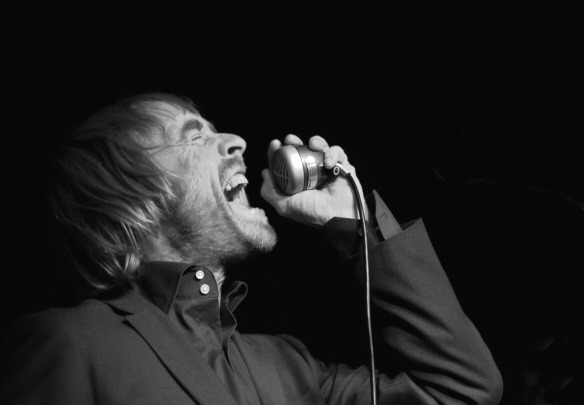
A conversation with Danny Green of Laish


Laish’s new album Obituaries
is released on 25th March. It’s another terrific collection of songs, with all the usual wit and pathos we’ve come to expect from one of Brighton’s finest songwriters.

Laish head honcho Daniel Green met up with our own Brighton Music Blog resident songwriter from the Hiawatha Telephone Company to talk about the story of Laish, the new album and the art of songwriting.

HTC: So where did it all begin? Have you always written songs?

Daniel Green (Photo by Jason Williamson)

DG: I remember writing songs from pretty much the minute I learnt to play a few chords. I used to write songs with my brother (comedian Matt Green), he’d tend to write the lyrics and I’d write the chords.

HTC: Were they funny songs?

DG: No they weren’t, they were teenage angst songs about vague mythical women. I don’t know about you, but I don’t really remember writing songs, they kind of happen when you’re not really there and then you find a box full of papers and ask yourself how did you do that.

I remember finding a box of songs and lyrics I’d written when i was about 14 or 15 so I have been doing it for that long but I don’t really remember them and I couldn’t play any of those songs now.

HTC: So when did you start performing?

DG: Pretty early. I was at a school where there was a music teacher who was enthusiastic and encouraging to anyone who would pick up an instrument, and I was playing drums and electric guitar so he said you’ve got to form a band and I remember singing some covers, at the age of 15, and singing a Manic Street Preachers song at a school assembly.

But there was quite a gap between that sort of thing and Laish. I went to university at 18 and stopped performing music pretty much. I had a guitar and a 4-track recorder with me, so I occasionally made a few hideous demos but nothing very serious and music wasn’t an ambition at that point and I got more into drama and the usual university shenanigans. Music didn’t seem like something serious that I could do. I didn’t have any friends who had done that.

Then after university I went to India for a year. Just before that I’d been to the Green Man Festival. Bonnie Prince Billy was headlining. And I just remember picking up a guitar and trying to remember songs around the camp fire. It was when the festival was still small and the bands used to hang out around the campfires and sing songs and it was all very jolly and I just remember a few people listening to my songs and saying “You’re quite good at this, you should probably do this some more” and up to that point I had never really thought of it as something I could do. So, it all started at the Green Man Festival.

And then I went to India, travelled around for ages. and bought a cheap guitar and got quite excited out there, just playing simple stuff. I don’t think a single India song has re-surfaced in Laish, it was all drivel (laughs).

HTC: It wasn’t going to be the Beatles’ White Album?

DG: No. Then I came home and started a band in Newcastle and we played a few gigs but I decided to move to Brighton and Laish was born there.

HTC: Was it just you initially?

DG: I just decided to make a name for better or worse, and I still can’t decide if Laish is a hideous name or a good name (Ed note: ‘Laish’ is a Hebrew word meaning the tribe of Dan), but I remember putting an advert in Edgeworld Records looking for band members and about 4 years after I put that advert up I was still getting phone calls from people asking if I was still looking. Did no-one else put an advert up in there?

HTC: And then it closed down. (Edgeworld)

DG: Yes. So I decided I was going to start recording music under this name Laish and I guess I thought it was like the Bonnie Prince Billys and the Smogs of this world who have this name but it’s not really about being a band or solo and you might see them as either but there’s always going to be a core songwriter there and that was what I was going with. And funnily enough that’s exactly what happened.

HTC: So when did you move to Brighton?

DG: I think I moved to Brighton in summer 2007.

The initial band was a guy called Bob, a girl called Fiona and Jess – who now plays in Fear of Men.

HTC: Another good Brighton band. I’ve been listening to their album of early singles and extras, and like it a lot.

DG: Well Jess was part of the foundation of Laish. But that kind of fell apart. The band who made the first album was Cathy Cardin singing, her voice is on the first album a lot, and Ben Gregory on bass, Mike Miles on drums and Jo Burke on violin. And that was a fairly stable line up until it also kind of fell apart and I started again from scratch.

There was an interlude when I found Jen Rouse. We had a tour coming up and Cathy couldn’t do it so I thought we’d get someone else in. I think we found her through Gumtree. Jen’s great, still a really good friend – I went to her wedding – but at that particular time she’d only just moved to Brighton, we went on a tour and it was all very stressful with big gigs and headlining, shit like that. It was very intense and then suddenly it wasn’t. And the band went pfft again. Ben was off on tours with other bands and doing some tour managing. Mike was off with his other band and Jo was on tour with the Medieval Babes in America for months. I was literally left without a band anymore, they had all just buggered off.

So I started doing a few solo gigs and then gradually Emma from Sons of Noel and Adrian decided to join, and we asked Martha and then Patrick was living with Dan the drummer and that all happened within about two weeks of me thinking Laish was finished. Suddenly  it’s not!

HTC: But it’s a funny kind of band, because everyone in the band does other things. Most bands, the members are in the band and that’s all they do.

DG: That seems to be a Brighton thing, there’s something in the air, people can’t bear to just do one thing.

HTC: You drum with the Sons of Noel and Adrian, Patrick’s in the Sons and Emma as well, and Emma does her solo stuff and plays with Mariners Children. It must be a logistical nightmare?

DG: And now Martha lives in Berlin. Dan (the drummer) is the only sensible one who just plays in Laish.

HTC: I thought your last UK tour was very economical, where you had Emma and Martha as your support acts.

DG: Yes, we’re going to do that again. Martha and Emma always go down well because Laish are on the cusp of folk and they probably fit more into the folk side of things so it’s a nice kind of crossover to have at a gig. It just gets progressively louder as the evening goes on. If you come to one of those gigs it’s like you get to meet the girls first, one at a time, and then there’s the full band.

.HTC: It’s kind of like an introduction. And it’s a nice contrast, with your slightly northern, masculine element and then the two girls. It makes for an interesting combination.

DG: I guess I’ve always liked that combination of male and female voices. It’s basically Leonard Cohen, that’s what it comes down to. He’s the archetypal model for that sort thing. I don’t think he was an influence when I set out making music but as I’ve listened to him more I can see he’s obviously a big influence in terms of the sounds we create.

The fact that Emma and Martha were in the band meant we could suddenly experiment with that. It wasn’t like we wanted a band with two girl singers, it just happened.

HTC: And they definitely add something to the presence on stage because they’re very comical…

DG: Yeah, they upstage me the whole time!

HTC: …but the songs are good enough so that doesn’t matter! And although you’ve got more rocky of late, your songwriting still has lots of soft sides. It’s not folk but it’s not ‘rock’ either.

DG: No it definitely isn’t. I think I’m veering towards being a bit noisier. But I find I’m always caught between the idea of writing a song for the stage and writing a song for an album and I never know which one i’m trying to do at any given moment. Often I’ll write a song sitting in a room by myself and I’ll pick out some nice finger-picking and it’ll be a quiet folk song, but then I bring it to the band and it becomes a massive rock song and so maybe it’s nice for the recorded version to be different. It’s a trick used by many bands – when you go and see them live, they turn it up. I’m interested in that, but it’s not really rock music is it?

HTC: No, but it’s not folk music either.

DG: I think Martha’s violin gives it that feel, but it’s not folky. I just read a review today that started by saying we’re known as ‘indie folk’ like it’s some hideous brand…

HTC: Mumfords all the way…

DG: But then they described us as baroque rock, and I thought that’s not really what we are, and they said we sounded a bit like The Miserable Rich, another great band from Brighton, but I just don’t see it. I guess the fact that there are strings and there are songs…
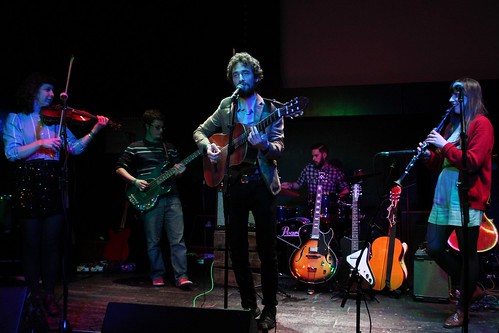
Laish

HTC: There was a phase a few years ago, when there was like you, the Mariners children, the Sons, Shoreline  – all these bands with similar sounds and sharing players and it was almost like there was this one sound…

DG: The Willkommen sound…

HTC: …whereas now it’s pretty diverged…

DG: I guess everyone got lumped together with the Willkommen Collective thing. I’m sure it’s been useful to us in terms of generally spreading the word, and on a social level and it got me a band, although we could have done that without the label, we didn’t need to give it a collective name to be friends or to play together, but I don’t know what it means now. We’re all still here, still making great music but it has definitely changed. The label doesn’t exist anymore, but we still put on gigs, and we all make music. We still like each other (laughs)

HTC: So it gives you a resource, and if nothing else a good mailing list. I wanted to come back to the masculine-feminine thing though because the sound is one thing, but it’s also there lyrically. I’ve always loved the humour in Laish songs, the tongue-in-cheekness, and an immense positivity which is really different from the charicature of an indie band ‘look, the world is terrible and we’re really depressed’ but Laish isn’t like that.

DG: I often find myself at gigs thinking all my lyrics are a bit miserable and depressing. Like “I don’t know what to do with myself, maybe I should just give up and go try something else…”

HTC: But that’s a perfect example. Because the traditional thing is “I just don’t know what to do with myself” full stop, a bit morose, whereas yours is humorous, “maybe i should go and try something else” whilst performing in a band on stage! It encourages a wry smile, but you don’t feel that?

DG: Not for that particular song. Obviously there are joke lines in some of my songs and I guess inspired by the Leonard Cohens or Bill Callahans of this world, that kind of deadpan straightfaced humour in song, where you have to think about it and realise that he’s taking the piss. I guess it’s a bit like that when I sing “I’m a serious man” and you can kind of feel like everyone’s thinking ‘no you’re bloody not’.

HTC: There’s a lot of Laish songs like that. One that I really love is the last song on the first album, ‘A happy accident’, about being born due to a hole in a condom. Where did that come from?

DG: That was written at a point when quite a few of my friends started having babies and I wasn’t really up for the idea at the time and I just remember thinking about one particular couple, well I didn’t really think it but the idea came into my head, that you wouldn’t put it past her [to make a hole in a condom], you know what I mean?

And then I took that idea and wrote it from the perspective of this child that had grown up because of a mother’s deceit and a slightly wet father that doesn’t really know what’s going on but just goes along with it.

HTC: It’s a brilliant song. And when it’s sung it always sounds like it’s completely about you and so personal because…

DG: I know and I feel really bad about that, because my parents come and see me play and the fist line is so brutal about my father, a father. Sorry dad, but it’s not really about you! I mean I’m sure my father is a troubled man, but not in that way. Just as troubled as anyone else is.

HTC: It’s interesting that when you put ‘a father’ and ‘a mother’ in a song everyone will immediately think it has to be personal. I have a song like that (‘Child is father to the man’). It’s such an intimate relationship, it’s like ‘Why would you write about something that intimate about somebody else’s father and mother?’

DG: I don’t know. The ‘I’ in a song is always open to suggestion. That’s a whole other conversation about the autobiographical element in song, but to me it’s completely irrelevant, it doesn’t really matter.

Or even the lyrics alone, it’s the whole package not just the words, but what’s going on with the music as well.

HTC: It’s the difference between autobiographical and literal. Every song comes up through the songwriter’s experiences somehow, but it doesn’t mean it’s all accurate and true. The song ‘Obituaries’ is kind of interesting from that perspective…

DG: How do you take it?

HTC: Well, I used to love reading obituaries because it was like a whole life story in a couple of paragraphs, and they were usually really interesting because to have an obituary written you’d think the person would have to have had something interesting about them otherwise why bother. It was that idea of capturing a story in this tiny space, a bit like a song….

DG: That’s my answer!

HTC: …but it’s obviously an important song for you. Not only are there two versions of it on the album but you named the album Obituaries.

DG: I already regret that – I’m worried that people will think it too miserable – but everything you’ve just said is relevant, I like the idea of songs as obituaries. I mean everything is contained in them, but nothing is contained in them. You can tell a story but you condense a lot into it.

HTC: I used to introduce my own song Richard and Liz sometimes as having ‘the whole of life in it’ which it kind of does, as it references love and death and gangsters and movie stars, but it’s that idea of having all of life in that little contained space. But why two versions and then name the album after that song?

DG: I don’t know. I guess I like the idea of the live version and the recorded version, it seemed like one of those songs it was interesting to rework. We’d done it before to other songs but then not always recorded the alternate version, and the original idea was to begin and end with it but that didn’t really feel like it was working and also once we’d recorded the slow verison it didn’t really fit anywhere on the album so we thought either we cut it, or we stick it on at the beginning, and then I thought that would be quite nice as it gives you a sort of dark brooding introduction that draws you in, and then boom – hit single – track two! (laughs)

I guess with all of these decisions there’s never really a master plan, it’s just a case of trying to put all the pieces together in a shape that makes sense and that makes a sort of narrative out of different songs that are in reality about different things. There’s a thread I suppose, I mean a lot of the songs are about death and a lot of them about sex and it’s about trying to reconcile the two, so yeah…  (laughs again)

HTC: Have you read Georges Bataille?

DG: No. Sex and death? It’s the oldest trick in the book isn’t it?

HTC: We should talk more about the album. It seemed quite a long time in gestation because i remember you talking about it being ready a while ago.

DG: Yeah, I don’t know. I’ve been doing this for five or six years now, from start to finish, and I guess the more I do it the more I can see that being a musician is a very seasonal thing, like there’s a time for writing and recording, and there’s a time for going out and playing gigs and the season for touring is February to May-ish, festivals in the summer, September to November for another bit of touring and then anytime inbetween is kind of dead time where its either too cold or too sunny and so you have to work around those constraints. And then there’s always going to be distractions, there’s always going to be life that gets in the way but the music’s always ticking over, I’m always thinking about the next thing.

I’m already thinking about the next album although we haven’t started recording it yet, I haven’t really decided which songs although there’s lots of new songs kicking around. It just takes a bit of time and I have to do it in whatever time becomes available and then it kind of happens and you just know when it’s ready. It takes as long as it takes. It wasn’t like there was something that delayed us, it just took as long as it takes.

I’m always amazed by bands that can knock out an album a year, or even more. You think ‘well done, great’ but it takes me about two years to do an album. And because it feels like we’re more of a band now, rather than the Daniel Green show, we spend more time on the arrangements and then everyone else’s time becomes important too, and they might be off doing other things, like Emma’s playing with the Mariners and Martha’s in Berlin so it’s tricky. After this interview, I’m going down to the studio to meet Dan and we’ll work on some new stuff, just me and Dan, guitar and drums. Normally there’s all of us, but when there’s only the two of us I’d rather get together and play than sit around at home.

You think you take two years to do an album but how much time is there really available?  One session a week when you’re working? How much can you do in that? You might rehearse one song, but then you won’t nail it in one go, so one song can take three months before you’re even ready to record it. It’s a lot of work.

HTC: The new album’s a lot richer sonically compared to the first one. The recording’s a lot richer. The first album sounded more folky whereas the new one sounds more produced. How did that come about?

DG: The found sounds were always something I liked to do when I was recording, you know if I had a bit of space in a song I’d stick a microphone out of the window and see what happens. Get some sounds of some birds or some rustling paper or whatever. There is still that on the first album but it was still me coming to grips with how to record stuff, where I was learning but not fast enough. With this one I knew a lot more but the difference in sound is a lot to do with Mike Steer who mixed it. He really knows his stuff and he really spent a lot of time on it.

Basically, the album was recorded at home but then handed over to Mike to make it sound good. As I was recording it I was mixing it but as I was mixing it I realised how incapable I am at mixing because, well… you go – the guitar sounds good, to my ears, the drum sounds good, to my ears, and the violin sounds good and everything sounds good but then I’d put it all together and it sounded like shit and I don’t understand why.

Luckily I met Mike at a gig where he was doing the sound and he said if I ever needed anything doing… and so I said ‘Yes, I need an album mixing right NOW. Will you do it?’

So I gave him a track and he mixed it and I sent it back because I absolutely hated what he’d done with it and I was going to ditch him when something in me said that even though I hated it I could tell that what he’d done showed he really knew what he was doing, he just hadn’t done it in a way that I liked. It was a taster but I didn’t really like the direction he went in, but when I got him on the right track then he was away. It meant it came out more pop than it would have done because I’m just not capable of that. Not that poppy I suppose, just a bit more accessible.

HTC: The first track I heard that made me aware of that difference was the Obituaries single released last year because it sounded so different. Partly that was the new band I suppose, but also the arrangement, the way the song was constructed, different…

DG: I do think that song is a bit of an anomaly for us though, I don’t really think there are many other songs that sort of sit with that song. It’s a bit of an oddball in a way.

HTC: It felt to me more like a statement of intent. That Laish weren’t going to be in that old folksy mould anymore.

DG: I just wanted to make some noise. Like when the drums kick in, what you hear is white noise and that’s what I wanted to be there. I didn’t want it to be like a folk band playing a bit louder.

HTC: Are you going further in that direction with the new stuff? Is there going to be more change?

DG: There’s definitely going to be more change. The constant pull between writing delicate folk songs and pop music. I’m not quite sure where we’re going but everything’s changing and I’m not yet sure what direction I want to take it in. The only thing I’m certain about is that I want to make music that’s suitable for a bigger stage.

I think it’s clear Daniel Green and Laish are set to play on bigger stages.

Daniel Green (Laish, UK)

The new album ‘Obituaries’ is available on March 25th. It can be ordered via their bandcamp site and should be available in all good music stores.

There will be plenty of opportunities to see Laish in the Brighton area before they head out on their next national tour. First of all Danny is playing a solo set at the next Source New Music Night at the Dome studio theatre on 28th March. There’s a small in-store to accompany the album release at Union Music Store in Lewes on April 13th (3pm), and solo support slots for Danny and Emma at the Six Toes gig at the Prince Albert in Brighton on April 14th.

You can catch the full 5-piece band at their headlining show at the Prince Albert on Friday April 19th which kicks off their tour.

They also play Meadowlands Festival on 26th May and the End of the Road festival at the end of August.

More details about their forthcoming UK tour and other stuff are on laishmusic.com or via their Facebook page.

So go forth. Enjoy the Laish. 


Interview with The Self Help Group

Mark Bruce is songwriter and leader of Brighton’s new folk-rock maestros The Self Help Group whose fabulous new album is being released on the Union Music Store label next month. Jon Southcoasting met up with Mark and asked him to tell us more about the band.

Needles video screenshot

Who are The Self Help Group?

The Self Help Group are, Me, I sing and play the guitar. Clara Wood-Keeley and Sarah Natalie Wood are the good looking side of the band. They are sisters and grew up in Plumpton I believe. Paddy Keely plays guitar and banjo and hails from Selsey. Ian Bliszczak plays bass and spent his idle youth with myself in Peterborough. We have recently been joined on drums by Jamie Fewings who is from Yeovil.
How did you get started?
I had been musically moribund for years since my youthful days in a shoegaze band. When my wife and I bought a flat, I utilised the loft space as a studio, and started writing songs again. Mostly for my own amusement. Friends encouraged me, I started toying with the idea of getting a band together. With the help of some (brave) friends I managed to start The Self Help Group.
There have been numerous changes to the line up before this one, the biggest change being the acquisition of the girls . They started singing and harmonising together at 11 years old in a band called Skyline. Then sang in 10 piece jazz/funk band, followed by their own writing project ‘Tamashi’. All involved close harmonies which fitted perfectly with the sound we’d been aiming for with this band.
How did the link up with Union happen?
Jamie and Stevie invited us to do an in store performance for them at their shop in Lewes. The idea of recording an album for them started forming not long after and became a firm plan after a gig at the Green Door Store back in Jan ’12. 
We started recording in March and the album was finished in October. The album was recorded for the most part in Jamie (Freeman)’s little studio just outside Lewes. Jamie recorded and produced the album. He was definitely a member of the band and had a massive input and influence on making the album as good as (I hope) it is.
The album has a very lush sound. Who writes the songs?
The album is quite BIG at points isn’t it? There is a lot going on. I write the songs. Some come to the table fully formed, but, as time goes on we are fleshing out sketched ideas in rehearsal much more.
The songs are all written in the same way. I will usually come up with a melody while playing guitar. There is a folder on my computer full of odd news items I’ve found and I  have a look in there and try to see which story fits the feel of the music. Then I pick at  the story and write the lyrics. 
Some of the timings of the melodies definitely have a slight funk timing to them but you would never get that from the music unless you were trying to play the parts I think. I’ve never really known what I was doing as a songwriter and had no formal training in music. As a result, the songs are all very simple and there is still a big part of me that is secretly afraid that someone is going to find me out!
There’s a song on the album called the 5th man on the moon. Who’s he? And who is Big Nose George?
The 5th man on the moon was a guy called Alan Shepherd. I read a letter that he wrote to his parents the day before he enrolled in the space program and it interested me. The man inside the space suit. It must have been pretty hairy stuff going into space back then. 
Big Nose George, the song, is older than the band. I wrote it in about 10 mins after spending about 4 hours recording a load of old tosh. He was a wild west criminal called Big Nose George Parrot. Long story short, he was eventual caught and hung. The governor of the county at the time ordered that he be sent to the local tannery, where his skin was made into a pair of shoes which the governor wore for special occasions.
Who are your influences? 
I’m always unsure who our real influences are. I don’t listen to as much music as I used to. I’m too busy chasing a 2 year old around the house and then recovering. Most of the bands that get mentioned in connection with our sound, I know little about. I guess that’s a good thing. 
I was a massive fan of The Smiths in my teens, then the whole shoegaze scene. Funk and soul music played a big part in my late 20’s. Now I listen to more mellow, acoustic stuff. 
I hope I’ve absorbed a little bit of all those things.
I also really love the latest Tallest Man On Earth album. The songwriting is so strong. One man and a guitar. I’m usually drawn to a much bigger sound, but that album is amazing.  I can barely make out a bloody word he’s singing though. And I know t

he girls are really liking The Staves at the moment. Hopefully they won’t try to replace me with another pretty girl. That would suck.
One last thing, the video for Needles is brilliant. How did that come about?
We had a lot of ideas kicking around as we were unsure what the single would be. I was determined to steer away from a stereotypical folk music video. The furthest thing from the norm seemed to be a dance video, so, that’s what we did.
Stevie Freeman (Co-owner of Union Music Store)’s sister Sian happens to be a choreographer. She offered to come up with “the moves”. It was a lot of fun shooting the video, in an old workshop in Lewes, on a cold Sunday morning. The rest is down to Jamie who slaved over an apple mac editing for weeks, bless him.
* * * * * * * * * *
The Self Help Group’s launch show on 7th February in Brighton is sold out.

The album ‘Not Waving But Drowning‘ is out on February 11th. But they are playing a free in store show at Union Music Store in Lewes on this coming Saturday at 3pm. It will also be your first chance to pick up a copy of their album too, a week and a half before its official release.

Words & Music by Saint Etienne, Conversation by Pete Wiggs

The premise of Brighton Music Blog is nice and simple – write about bands from Brighton. So what am I doing interviewing Saint Etienne’s Pete Wiggs? The band have a greatest hits called London Conversations, and London Belongs To Me from Foxbase Alpha came 19th in Time Out’s 100 best London songs last year. Surely I can’t be branching out so soon? Don’t worry. The blog is still dedicated to Brightonians – Pete Wiggs is a Hove resident these days, so I caught up with him over a pint or two at his local to talk about moving away from London, his new album, and making remixes for a new generation of artists.

Saint Etienne on Brighton Beach (photo (c) Elaine Constantine)

It’s funny because even now we still do interviews where people ask me my favourite London haunts. I’ve been down here for four years now. I still feel like a tourist now and again here. We’d always intended to move down here at some point, and now I can sometimes go a couple of weeks without going into London. I suppose it’s easier with internet – you can bat things around. Continue reading

The Impellers Interview

I say The Impellers, but actually, I’m just meeting up with one of them. The Impellers are a ten piece funk band, but I’ve popped down to The Basketmakers to catch up with main man Glenn Fallows (known onstage as Ed Meme), in advance of their new seven inch being released next Monday.

Glenn Fallows of The Impellers

RO: The single’s called…

GD: The Knock Knock. We supported James Taylor Quartet in 2010, there’s some stuff on YouTube from that show, and that was one of four or five tracks from that was uploaded. I think that was the first track I’d written after the first album came out, so it’s been around for quite a long time now, but it’s sort of evolved a bit more. The live version’s got all kind of extra added solos, and a bit of rock at the end, and we like to mess with the tempos at the end. The outro’s longer than the actual song itself. The 7″ is just three and a half minutes of dirty funk.

RO: And the b-side’s another indie cover version?

Continue reading

Thomas White Interview

This week sees the release of Thomas White’s new album Yalla, and I thought I’d find out a bit more about from him via the pubs he lists in the lyrics of the closing track English Sargasso: The Dorset, the Hand in Hand, Fitzherbert’s and The Globe.

Thomas White - Yalla!

We start things off at The Dorset, or to give it it’s full title, The Dorset Street Bar. There are records of The Dorset being a pub going back to 1845, so it’s been a firm fixture in Brighton for quite some time. Continue reading

Sea Monsters 2 CD / Tyrannosaurus Dead interview

One Inch Badge, who put on the recent Sea Monsters gigs at the Prince Albert, have put out a cd with one track from every band who played at the festival. For now, you can buy it from their web shop here or from Resident or Rounder in town for a mere five pounds. It gets an international release on 9th April. If you want a listen first, here’s the soundcloud widget. But why not just buy it. It’s only a fiver! You can’t go wrong spending a fiver on a cd. That’s less than two pints!

Rather than do a review of the CD, since I reviewed every gig of the festival (and since you can listen for yourself), I decided to catch up with one of the bands to talk about things from their perspective. On a wintry January Saturday lunchtime, I caught up with Billy Lowe and Tom Northam from Tyrannosaurus Dead, who played on tuesday night’s gig and whose track 1992 is on the cd, to talk about Brighton, Gigs, 1992, and not singing in American accents.

Billy Lowe, lead singer of Tyrannosaurus Dead

Billy Lowe, lead singer of Tyrannosaurus Dead

On the Brighton connection:

BL: I went to Sussex University and had the best time. Tom and I are both from Poole in Dorset, and have known each other since we were about ten or maybe even younger. I lived here for years, I was in different bands, but lack of opportunity for work means I live in London at the moment, but I’ll definitely move back at some point, we play here all the time. Everyone else in the band still lives in Brighton.

TN: Billy set the base up for us all living here. We had all our friends in Poole – Billy moved here to go to university, and then his brother moved down, half of our friends moved here, we made friends with all of Billy’s friends that he made at uni, and I’ve just gone back to uni last year at 25 to study maths at Sussex, and now all of the rest of our friends have followed me, so the whole Poole group has moved to Brighton now.

BL: I think the reason people like coming to Brighton is that it’s like a micro-city – you’ve got venues all close together, you’ve got a really nice fashion scene, really nice art scene, you can walk everywhere, you don’t have to get on a tube, you don’t have to get on a bus – that’s what I love about it – that you can go to Brighton Live, or Fringe Festival, or Great Escape, or anything like that and just walk to all of the different things. The only trouble is that after you’ve lived here for a few years, it’s impossible to walk around and maybe see people that you don’t want to see!

TN: I’m even seeing people now that I’ve known from other past lives – I lived in Southampton for three years and I see people about in Brighton and it’s like “I went to uni with you, I went to that pub with you…”

On gigs:

TN: We’ve been quite lucky, our crowd is getting bigger at the moment. We’ve started seeing in the last couple of gigs people coming along who aren’t just our friends, and people will come up to us after the gig and tell us we were really good. It’s good to get feedback like that because your friends are always going to tell you you’re really great aren’t they?

BL: Yeah, and you don’t necessarily like the same music as your friends. They’re supportive – when you first start out you have to draw on your friends so much to come along otherwise you’d never get off the ground. But it gets to a point where your friends have spent so much on going to gigs and they’re like “I’ve seen that set a couple of times now, I’m gonna leave it” and then of course you need to start getting other people in and luckily we’ve managed to do that.

RO: I guess Sea Monsters was really good for that because people would go because it’s Sea Monsters, or they’ll go because it’s Fear of Men and see you as well…

BL: I’ve seen Fear of Men before in London and I’ve always thought they were really good. But we’ve been really lucky with Sea Monsters, because they really plugged us and that definitely helps. When we came on we had a nice big crowd and I think that was probably because they said 1992 was a really good track.

RO: On Soundcloud, yours is the second most listened to track on there, after the Restlesslist track.

TN: Which is pretty mental really. Restlesslist are the first track on the cd, so everyone’s going to start listening from that point, then you scan down and I think it’s a bit of a snowball thing – people see “oh, they’ve got lots of hits, what’s that one?” and then more people click on us because we’ve got more hits.

BL: When there’s twenty odd tracks, you’re not going to sit and listen to twenty songs, so you look at what draws your eye, and possibly because they mentioned the track in the Source rather than just the band, people might have listened to it. I thought we would be right at the bottom of the cd, but just being next to Fear of Men, getting mentioned alongside them is great. The association we’ve got with Fear of Men is amazing – obviously they’re way ahead of us.

RO: How did you get to be on the bill at Sea Monsters?

TN: We launched our EP down at Fitzherberts – we hired out the top room, we got a couple of local bands, Two Jackals and Hockeysmith to play with us, put it on as a free night, and the One Inch Badge guys happened to be drinking downstairs. We packed it out, you couldn’t get in to the room we had upstairs at one point, and the rest is history.

Tyrannosaurus Dead at Sea Monsters 2

On 1992:

BL: I was maybe nine years old, so I was probably learning maths in 1992…

TN: Same thing that I’m doing now!

RO: So where does 1992 come into things?

BL: When you get a bit older the time of stuff that happens that you like doesn’t quite correlate to where you are in your life, so we really like the Pixies and Nirvana, but when we were 9, we would have found it hard to relate to anything like that. It loses it’s place in time with your life. It’s also a reference to the way the music was changing at that time, not specifically 1992, but in the early 90s. In England, you had a hangover from the late 80s indie scene which had some of my favourite bands, and a little bit into the 90s American music was hitting it’s peak with grunge coming in, whereas in England we lost a lot of bands that I really liked and went into a new phase of Britpop which was after the high point of guitar music in this country. So the song’s saying that the end of something isn’t necessarily the best of it. I think that’s how British music was then, and I don’t think it’s ever truly recovered.

TN: Plus Waynes World was released in 1992!

BL: Years in songs always tend to sound quite good – 1979 by Smashing Pumpkins is one of my favourite songs ever. Melodically it works quite well to add a year into songs, and a year’s an easy thing to relate to because you know where you personally were in that year.

On accents:

BL: When I first started, quite embarrassingly, because I like those American bands, I’d not sing in an American accent, but pronounce things a little bit more American, and it’s the wrong way to go. Belle & Sebastian and other Scottish bands, their delivery is really nice and their accent really comes through, and you can really hear what they’re talking about. Sometimes when an English person sings in an American accent, it’s a bit contrived, and it’s difficult to relate to it because if they’re singing in an American accent, are they really meaning what they’re singing about? So we really made an effort to sing in our own voices and because of that it sounds very English. Eleanor who also does vocals has a very English voice. Singing in your own accent is a lesson you have to learn. When you try and sing in any other way and you listen back, it’s embarrassing.

Tyrannosaurus Dead are playing at Late Night Lingerie on 24th February and are supporting Spotlight Kid on 2nd March, both at Sticky Mike’s Frog Bar, and are heading into the studio in April to record their debut album.

words and pictures by Rob Orchard

The Brighton Music Blog Big Interview : The Repeat Prescriptions

After several months of news, reviews and links, I’ve finally got around to the first Brighton Music Blog interview. It’s a rainy January evening, and I’m meeting Simon Bate and Alex Borg in The Gladstone. They’re two fifths of new band The Repeat Prescriptions, and when they’re in the band, they assume pseudonyms and take on a rather interesting back story…

Simon Bate onstage at the Prince Albert

RO: Hello. Who are you?

SB: We’re the Repeat Prescriptions, and we basically play loud raucous rock’n’roll from a distant past.

RO: Tell us about this distant past…

SB: My name is Smuj E Koknokka, and in the summer of 1965 I moved from Ohio – I was a simple farming lad – to the bright lights and big city of LA, but obviously there was no money in it initially so to subsidise my meagre income as a musician, I got a job in the adult film industry as a fluffer, and I was on the set of Gorged that I met the director Ju Ju Sharp, who was a guitarist, and we formed the Repeat Prescriptions. We penned a lot of songs and did a few gigs, we met this gentrified English chap, who was heavily into the brown acid, called Marmaduke Marshall…

AB: Good Evening

SB: …and he was hanging out with a guy called Sandy Hoxton, who was a drummer, who was a surfer boy, wasn’t he?

AB: He liked girls and he liked riding the waves.

SB: Riding waves and women.

AB: That’s all you really need rhythmically. He was always going to be good on drums, wasn’t he? Sandy ‘Sticks’ Hoxton – the ‘Sticks’ is very important, that has to be there otherwise he gets a little bit diva-ish.

SB: What about Brian ‘O Brian’ Brian?

AB: Well he was playing keys for Hendrix, sessioning on some of his work which we don’t think ever saw the light of day, and it was through a friend of a friend we were put on to him and once he jammed with us there was no turning back and that was it.

SB: It was either him or Manzarek, but he was a little bit busy at the time. So in the late sixties – 68 – there was a very real prospect of being conscripted into the Vietnam war.

AB: Being fit, young men, as we are

SB: So we decided that maybe our market might be in the future so we decided to get cryogenically frozen. Keith Moon agreed that he’d ship us back to Brighton because he thought that when we thawed out in the 21st century we’d be a bit freaked out and that would be the ultimate place.

RO: So you’re back?

SB: Yeah, we’re back. We got thawed out last year. Obviously took us a while for our fingers to actually work again so we could play our instruments, but we’ve just started to do gigs again in Brighton – we played one gig already, we’ve got three booked up so far in the next month or so

RO: Which are?

SB: This Sunday, the 22nd, is the Green Door Store for Sunday Service. Two weeks after that we’re playing the Horse & Groom, up on Islingword Road with the Stash DJs, so that’ll be 50s and 60s rock’n’roll music, and then the 24th of February we’re playing the Brighton Ton Club which is a motorcycle enthusiasts day out.

SB: So we’re playing at that, we’re going to have burlesque dancers…

RO: Is that part of your rider?

SB: We’re going to have to start making stipulations for future gigs!

AB: I think we need some platforms for them, to the left and right of the stage

SB: Or if we can’t afford platforms, just get them to wear platforms, so they’ll just naturally tower over everyone else

RO: Next question – Are you planning to put any of this onto record?

SB: Yeah, yeah. We’ve come back and everyone’s doing digital stuff at the moment and I don’t really truly believe that you own something if it only exists as a series of ones and noughts, so I think what we’re going to do is release limited seven inch singles.

AB: Get some plastic out

SB: Make something tangible, it’s important that people can get something that can collect and hold that’s a bit unique, so each sleeve will maybe numbered or something like that.

AB: Something to make you feel warm and fuzzy inside.

RO: So, the blog’s all about Brighton – What do you think it is that makes Brighton such a creative place?

AB: It’s the people, isn’t it?

SB: I think Brighton is the closest we’ve got in England to Laurel Canyon in the Sixties, home to Crosby, Stills, Nash & Young, Jim Morrison, Joni Mitchell, Jimi Hendrix, … They were all neighbours and they all used to play with each other, and I think Brighton’s very similar to that.

AB: It’s a little hotbed of creativity. But only seven people in Brighton are from Brighton, apparently.

SB: Everyone seems like they’re imports.

RO: What are your favourite other bands from Brighton?

SB: I love Abi Wade…

AB: …Gentleman Starkey …

SB: … Lolly & The City of Flies, Lost Dog, Rocker Switch *laughs* <it’s worth pointing out that Simon plays with the last two bands mentioned>

RO: Do you think the success of Rizzle Kicks and the Maccabees (currently in the top five in the singles and album charts respectively) will help the music scene in Brighton?

SB: Well, I think anything that puts the spotlight on a particular area is good. It would be nice if we had what happened in Manchester when the baggy scene started up, everyone was looking at Manchester and there were these bands who weren’t even particularly good suddenly getting some sort of recognition.

AB: I’m going to be controversial and I’m going to say that it’s not going to make any difference, just because those two bands are completely different and they’re not really coming out of any scene.

SB: I suppose so. When the punters think of that, they don’t think instantly Maccabees = Brighton.

AB: I don’t think so. I don’t think there’s ever been a big scene in Brighton. There’s been lots of good bands doing their own thing, and just the ones that are really good at whatever do are the ones that shine. So Rizzle Kicks I think are great – I especially like the one about mums, and the video to that is brilliant.

AB: And the Maccabees are great. I think they’ve always been great, personally. That Pelican tune is fantastic considering they’re all about what, 21, 22?

SB: Still? They can’t be 21,22! They’ve always been 21, 22!

AB: They’re probably all 36. Anyway, I like it. It’s not boring drossy run of the mill indie.

RO: What’s your favourite venue to play in Brighton?

SB: I think the Green Door Store was what Brighton always needed. It’s got that Berlin shabby chic. It looks like a bombed out shell of a building.

AB: It’s very industrial there.

RO: It’s good because you can spill your pint and no one cares

AB: You can spill blood and nobody cares!

SB: All the girls I know there wear quite fancy shoes. That massacres your shoes. It’s basically like dancing on emery boards.

AB: It’s an orthopaedic war zone. That would make a good album title.

SB: It’s a concept album!

RO: So you love the Green Door Store…

SB: And the Albert. I think the Albert’s got great sound.

RO: A lot of the stuff that goes on at the Green Door Store kind of feels like the stuff that would have gone on at the Albert before, but it still feels like the Albert has got loads going on all the time. Any other venues you feel warrant a mention?

AB: The Hope. The sweaty Hope. It is incredibly hot. In the summer it’s almost unbearable but it just seems to be the perfect little sweatbox venue that holds about a hundred people. I’ve got a lot of happy memories from there. I’ve played there a few times, put on gigs there. It’s a weird venue, the road it’s on, you get the passing tourist trade and that can make it quite exciting sometimes. I always thought there was an air of danger from that place because you can get anything from football supporters to the complete other end of the spectrum.

RO: And what about the Hippodrome – the old Mecca Bingo Hall down on Middle street, which has apparently been bought up and is being done slowly up by Live Nation who used to be Mean Fiddler. It’s got history – the Beatles and the Stones played back in the 60s.

AB: Whenever a building of that historical significance, it’s great.

SB: I think it’s inevitable in a city the size of Brighton there’s going to have to be something like that. There is still a city centre gap…

AB: …and it’s going to have to be someone with some money and some clout to make it a successful operation. The only way that would work otherwise would be if you got some kind of community syndicate project to sort it out. That’s obviously not happened so somebody with some clout and some money’s gone in there.

SB: I still think places like the Albert and are going to be perfect for the homegrown bands, because they’re really nice places to go.

AB: It’s going to be touring bands that play at the Hippodrome, anyway.

SB: Anywhere would be better than the Brighton Centre. That’s a horrendous place to see bands. You might as well stick a ghetto blaster in the King Alfred Centre for the sort of sounds you get in there.

AB: I have a feeling it’ll be about the same capacity as the Dome, which does seem to go for the “still touring at the age of 60” middle of the road vibe

SB: It’s a seated thing isn’t it?

AB: That’s why all the good gigs are in places like the Hope or the Green Door Store. So many good ones happen when it’s just you and a fifty or a hundred people.

RO: Last Question: Brighton or Hove?

Both: BRIGHTON!

AB: Hove’s full of estate agents.

SB: Hove’s a little bit snooty. I love this side of Brighton. I love the area where I live.

AB: There’s nothing to do in Hove, except get on a bus and come into Brighton.

SB: Stick us down for two Brightons!

The Repeat Prescriptions play the headline slot at 9pm for the Sunday Service at the Green Door Store on 22nd Jan.